

How to Trim a Beard: A Clean, Controlled Routine
Learning how to trim a beard is less about chasing a perfect barber-shop outline and more about controlling the shape you already have. Start with a clean, completely dry beard, choose a longer guard than you think you need, and work in small passes. That approach protects your length, keeps both sides balanced, and gives you room to refine the finish.
Order The Full Swing Bundle for a complete beard care routine
What should you do before you trim a beard?
Before you trim a beard, wash away buildup, dry the hair fully, comb it into its normal shape, and decide how much length you want to keep. Do not trim immediately after a shower while the beard is wet. Dry hair shows the shape and length you will actually wear.
The preparation step determines how accurate the rest of the trim will be. Beard hair changes position when it is wet, then contracts and curls as it dries. If you cut based on that stretched, heavy appearance, the result may look shorter or less even once the hair returns to normal.
- Wash your beard with a dedicated beard and face wash, then rinse thoroughly.
- Pat it dry and give it enough time to air-dry completely.
- Comb or brush the beard in the direction you normally style it.
- Look at the sides, mustache, cheek line, and neckline from the front and both profiles.
- Set a conservative target length before turning on the trimmer.
If your beard is long or curly, use a comb to lift the hair gently before cutting. Do not pull it straight and then trim to the stretched length. The goal is to see how the hair naturally rests, not to create a temporary shape that disappears as soon as you let go.
Which tools do you need for a controlled beard trim?
A controlled beard trim needs a reliable trimmer with several guards, a sharp pair of small scissors, a beard comb, a mirror with good lighting, and a clean towel. Each tool has a distinct job: the trimmer sets bulk, scissors handle isolated strays, and the comb exposes the hair you need to cut.
- Beard trimmer with guards: Use guards to establish an even length and reduce the chance of taking off too much.
- Beard scissors: Use these for a few hairs that sit outside the shape, especially around the mustache and lower lip.
- Comb: Choose a sturdy comb with teeth that move through your beard without snagging. It helps you check the actual outline.
- Hand mirror: A second angle makes the underside of the jaw and the back of the neckline easier to inspect.
- Good lighting: Strong, even light helps you see loose hairs without forcing you to keep correcting the same area.
Clean your trimmer and scissors before and after use. A sharp, clean cutting edge moves through the beard with less tugging, while a dirty tool can drag product and loose hair back across freshly groomed skin. You do not need a counter full of equipment. You need a few dependable tools and enough time to use them deliberately.
How do you choose the right beard length?
Choose a length by starting with the guard that leaves more hair than your final goal, then make a second pass only if the beard still looks bulky. A longer guard is the safer starting point because you can shorten a beard gradually, but you cannot restore length after an aggressive first pass.
Think in terms of proportion instead of a single number. The beard should frame your face, connect naturally with the sideburns, and leave enough density to support the neckline and cheek line. If you are maintaining an established style, begin with the guard you used successfully last time. If you are changing styles, take off less than your ideal target on the first pass and reassess.
Keep the trimmer flat against the beard when setting the main length. Move slowly against the direction of growth only when you need to lift the hair and remove bulk, and use the direction of growth for a lighter maintenance pass. Growth patterns vary across the cheeks, jaw, chin, and mustache, so do not assume one direction will produce the same result everywhere.
| Goal | Best starting approach | What to watch |
|---|---|---|
| Short, even beard | Use one longer guard over the full beard, then refine the edges without a guard. | Do not make the neckline so high that the beard looks detached from the jaw. |
| Medium beard | Keep the chin and jaw slightly fuller, then blend toward the sideburns. | Check both profiles so one side does not carry more bulk. |
| Long beard | Comb through first and use scissors for isolated strays before reducing overall length. | Do not stretch the hair straight and cut to that temporary length. |
How do you trim the main beard length evenly?
To trim the main beard length evenly, work in small sections and make repeated passes with the same guard before changing anything. Start at the sideburns, move down the cheeks and jaw, then finish at the chin and mustache. Pause often, brush the hair back into place, and compare both sides.
- Attach the longer guard and confirm that it is locked in place.
- Start at one sideburn and move through the beard in slow, controlled strokes.
- Work with the natural growth pattern in each area instead of forcing one angle everywhere.
- Repeat the same sequence on the other side before making any shorter adjustments.
- Comb the beard down, then out, and inspect it from the front and both sides.
- Use the next shorter guard only on areas that clearly carry more bulk.
Do not keep running the trimmer over a section simply because it feels satisfying. Once the hair is even, extra passes can create thin spots that are easier to notice after styling. If you are unsure whether an area is too long, comb it, step back from the mirror, and reassess before cutting again.
For a fuller beard, preserve the chin and lower jaw rather than flattening every surface to one exact setting. A slight difference in length can create a stronger outline, while an overly uniform trim may remove the shape that makes the beard suit your face.
How should you shape the cheek line?
Shape the cheek line by following the beard's natural upper boundary and removing only obvious strays above it. A natural cheek line usually looks fuller and is easier to maintain than an aggressively carved line. Work from the sideburn toward the mustache, checking both sides before cleaning any remaining hairs.
Use a bare trimmer or precision detailer only after the overall length is set. Keep the tool steady and make short movements rather than sweeping a new line across the cheek. If one side grows higher or lower than the other, do not force perfect symmetry by removing large sections. Aim for visual balance while respecting the way your beard grows.
For a sharper finish, clean the small area above the cheek line with a careful, shallow pass. Stop as soon as the stray hairs are gone. The upper cheek is not the place to keep experimenting with shorter settings, especially when you are shaping a new beard for the first time.
Where should the neckline go?
The neckline should sit above the natural underside of the beard without climbing onto the jaw. A practical starting guide is about two fingers above the Adam's apple, followed by a soft U shape that runs toward each side of the jaw. Remove the hair below that boundary and keep the line gradual, not harsh.
Look straight ahead while you set the center, then turn your head slightly to check each side. The neckline should follow the curve beneath the jaw rather than forming a high horizontal stripe. A line cut too close to the jaw can make the beard look narrow, while a line left too low can make the lower edge look undefined.
- Find the center point above the Adam's apple.
- Imagine a shallow U that rises toward the left and right corners of the jaw.
- Mark the boundary visually before removing any hair.
- Trim below the line in short strokes, working from the center outward.
- Check the left and right sides from a second mirror angle.
Do not keep raising the neckline to fix a small asymmetry. If the line is slightly uneven, step away and compare the overall shape. A natural outline that follows your beard usually looks better than a perfectly straight line placed too high.
How do you control the mustache and stray hairs?
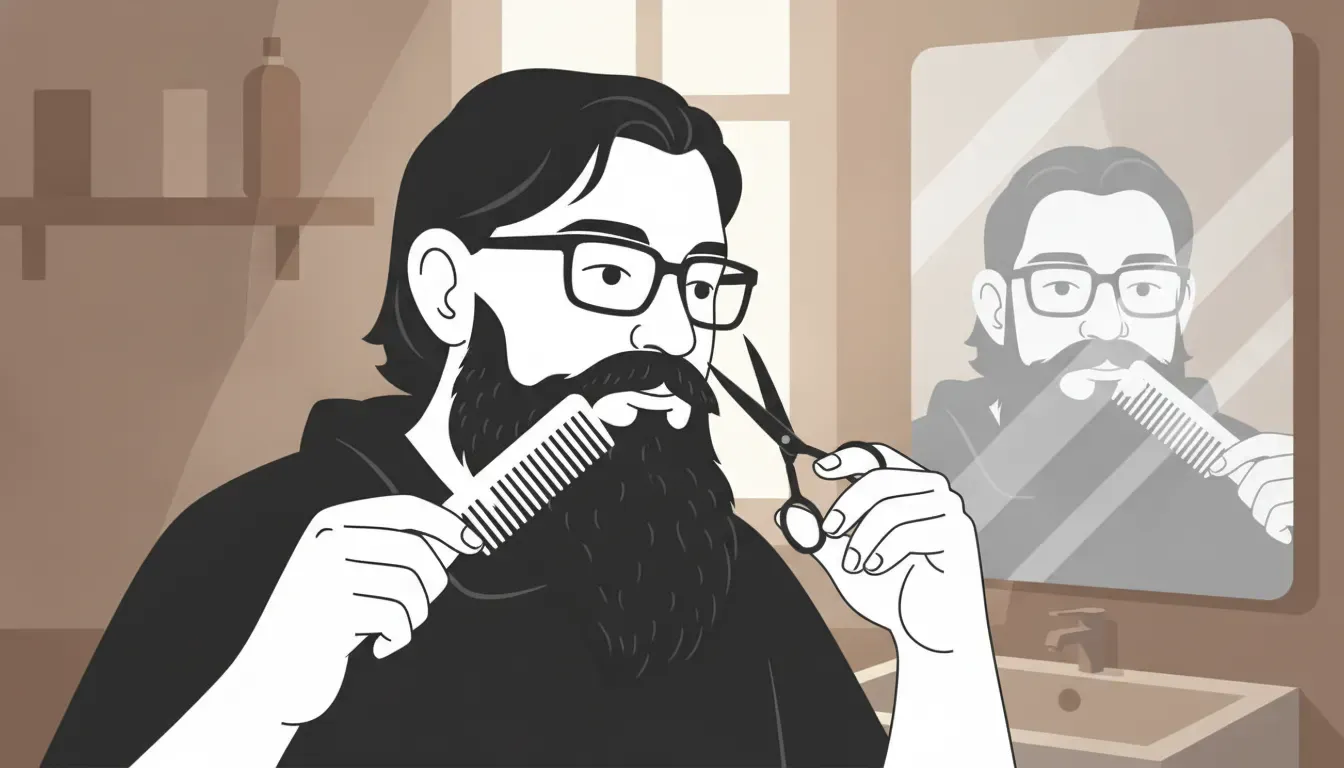
Control the mustache after the main beard shape is finished. Comb it down over the upper lip, then use small scissors to remove only the hairs that interfere with your lip line. Finish by checking the corners of the mouth, the lower lip, and any isolated hairs that sit outside the beard's silhouette.
Keep the mustache proportional to the beard. Cutting it much shorter can make a fuller beard look disconnected, while leaving long hairs across the lip can make the entire trim feel unfinished. Make one or two small snips, comb again, and stop when the outline looks intentional.
Scissors are also the best choice for single hairs that escape the trimmer. Hold the comb in the beard and snip only what extends beyond the shape. Avoid using scissors to chase every slight variation in length. Beards are made of hair that grows in different directions, and a controlled outline matters more than making every strand identical.
How often should you trim a beard?
Trim a beard whenever its outline stops matching the shape you want, not according to a rigid calendar. Many men can do a light cleanup of the mustache, cheek line, and neckline once a week, while a larger length adjustment may be needed less often. Your growth speed and preferred length should set the schedule.
- Short styles: Check the outline weekly because small changes show quickly.
- Medium styles: Maintain the cheek line, neckline, and mustache regularly, then reduce bulk as needed.
- Long styles: Preserve length and use scissors for isolated strays between larger shaping sessions.
Use the same lighting, mirror angles, and general sequence each time. Consistency makes it easier to see whether your shape is changing and prevents a rushed correction from turning into a major cut. If you are growing a beard out, prioritize the edges and mustache rather than repeatedly reducing the length you are trying to keep.
What should you apply after trimming?
After trimming, brush away loose hair, rinse or wipe the face clean, and apply a small amount of nourishing balm to the beard and the skin beneath it. A tallow-based balm helps add softness and manageable control without turning the post-trim routine into a long list of steps.
DALYSMOOTH balms use nutrient-rich beef tallow, naturally rich in vitamins A, D, E, and K, alongside conditioning oils and butters. Warm a small amount between your palms, work it through the beard from the skin outward, and use a comb to distribute it. Add more only if the beard still needs control.
If you have just cleaned the neckline or cheek line, keep the application light around those edges. The goal is a conditioned, natural finish, not a heavy coating. First Tee offers a clean, fresh profile, while Sandalwood Bourbon brings a warmer, woody profile. Choose the scent that fits your routine and wear it consistently.
What are the most common beard-trimming mistakes?
The most common beard-trimming mistakes are cutting wet hair, starting with a guard that is too short, raising the neckline too high, carving an unnatural cheek line, and correcting one side without checking the whole face. Most of these problems come from rushing, poor visibility, or making a large change before confirming the shape.
- Trimming wet hair: Wait until the beard is completely dry and styled as you normally wear it.
- Starting too short: Begin longer and reduce the length in stages.
- Chasing symmetry: Compare the overall appearance instead of forcing every growth pattern to match exactly.
- Raising the neckline: Keep the line under the jaw and use the Adam's apple as a reference point.
- Overworking a section: Comb the hair back into place between passes and stop when the shape is even.
- Ignoring the mustache: Finish the lip line and corners so the beard does not look half-done.
The best correction is often to stop cutting, brush the beard into place, and look at it from a normal distance. A mirror close-up makes every stray hair feel urgent. Step back, assess the full frame of the face, and make only the adjustment that improves the complete shape.
Shop DALYSMOOTH beef tallow beard and skin balms
Frequently asked questions about how to trim a beard
These answers cover the practical questions that come up most often when trimming at home. The consistent principles are simple: dry the beard first, start with more length than you need, define the neckline conservatively, and use a small amount of balm after the cut to soften and control the finished shape.
Should you trim a beard wet or dry?
Trim a beard when it is completely dry. Wet hair is heavier and can sit in a different position, which makes it harder to judge the final length. Dry the beard, comb it into the shape you normally wear, and then make gradual passes with your trimmer.
How do you trim a beard while growing it out?
While growing a beard out, focus on maintenance rather than reducing the overall length. Clean the neckline and cheek line, keep the mustache from covering the lip, and snip isolated strays with scissors. Preserve the chin and jaw so the beard can continue building its intended shape.
How do you trim a long beard?
Comb a long beard through in sections, let it settle naturally, and remove stray hairs with scissors before changing the overall length. If you need to reduce bulk, use a longer guard and make small passes. Check the front and both profiles frequently so you do not flatten the shape.
How do you trim a beard with scissors?
Use scissors for detail work rather than trying to replace the trimmer completely. Comb a small section outward, hold the comb steady, and snip only hairs that extend beyond the outline. Scissors are especially useful for the mustache, chin strays, and longer beards with uneven individual hairs.
How often should you clean your beard trimmer?
Brush loose hair from the trimmer after each use and follow the tool maker's cleaning guidance for deeper maintenance. A clean trimmer is easier to control and less likely to drag product through the beard. Keep scissors dry, sharp, and stored where the blades will not be damaged.


